

Freddie Villiers
At Arete Performance, we pride ourselves on helping athletes bridge the gap between rehabilitation and true high performance. Emma’s journey is a great example of how targeted intervention, patience and precise planning can turn lingering deficits into long-term progression.
When Emma first came to us, she was around 20 months post ACL reconstruction and subsequent cyclops lesion surgery. Although she had already returned to training and was available for selection, she still lacked confidence loading and moving off the left side during higher intensity actions and the chaotic demands that rugby naturally brings. Her main goal was to put herself in the best possible position for Sweden Sevens in the summer, while also improving her speed, movement efficiency and confidence during high speed actions.
Despite functioning well overall, it was clear there were still underlying physical and coordinative deficits limiting her ability to fully trust and express herself off the affected side.
Surgery Restores Stability – Not Performance
Increasingly, what we tend to see with athletes coming out of ACL rehab is the belief that once passive stability has been restored and they can tolerate load through range again, they’re automatically ready to return to high level sport. The issue is that early-stage rehab often does a good job of restoring basic strength and reducing symptoms, but can sometimes underexpose athletes to the coordination demands that actually underpin performance. Athletes may regain the ability to squat, jump and run in controlled settings, yet still lack the intra- and intermuscular coordination needed to organise force efficiently during high-speed sport.
I was recently speaking with one of the physios we work closely with, and he made a really good point: the body is incredibly good at cheating and usually, the better the athlete, the better they are at hiding dysfunction. They become highly efficient at finding compensatory movement strategies that still allow them to complete the task, despite not truly restoring optimal mechanics. This becomes particularly obvious during deceleration, reactive movement and change of direction tasks, where compensatory strategies often emerge despite “passing” traditional rehab markers. The missing piece is often not just restoring force production, but restoring the athlete’s ability to coordinate and express that force effectively in chaotic sporting environments.
Initial Testing
Strength & Power Profile
When we completed Emma’s profiling, it’s important to say that she didn’t present as globally weak across the board. In fact, she tested relatively well in several areas and was still capable of producing good outputs in more controlled tasks. But that’s often where these cases become interesting. Athletes can perform well overall while still showing key deficits that become highly relevant once you look deeper into how they’re producing force.
The main red flags were the asymmetries between left and right side, particularly through quadriceps and glute strength, alongside a single-leg RSI asymmetry of around 30%. She was also only able to produce around 1.2x bodyweight through the soleus on the affected side, which is below what we’d typically expect for an athlete preparing for high-speed running and multidirectional sport demands. Her hip strength profile also showed adductor dominance over glute medius function on the left side, suggesting she was still relying heavily on frontal plane stabilisers and compensatory recruitment strategies when exposed to higher speed movement tasks.
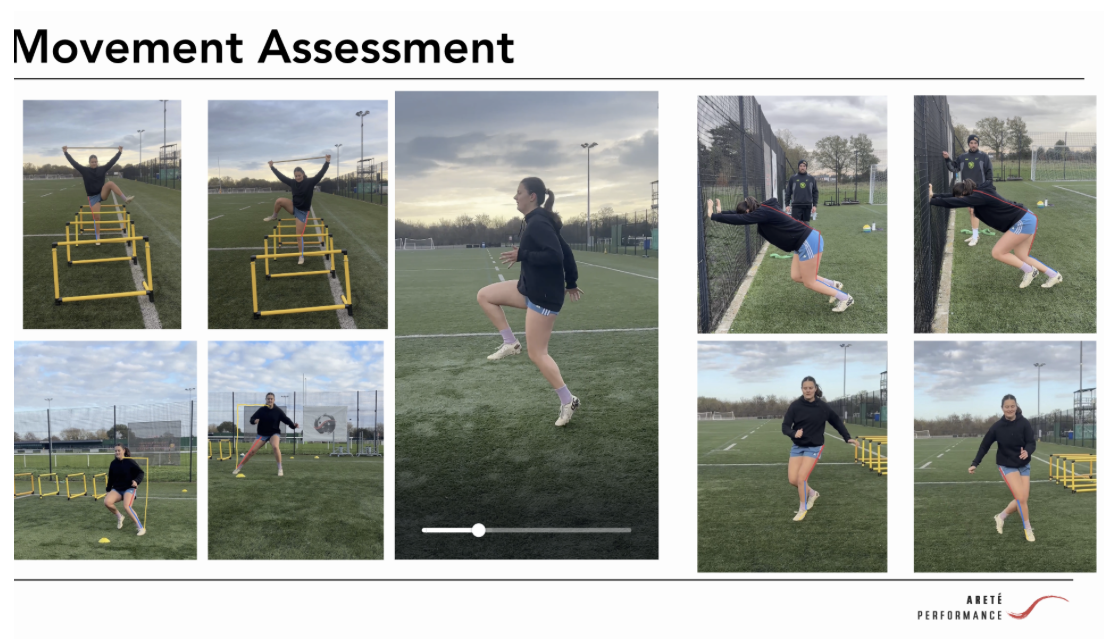
The movement assessment probably gave us the clearest picture of where Emma currently sits within the rehab process. In more controlled environments she moved relatively well, but once we began exposing her to more reactive tasks particularly deceleration, single-leg landing, lateral movement and change of direction patterns, a few compensatory strategies became more apparent.
The left side consistently showed reduced confidence and efficiency when accepting load, particularly through frontal plane control and trunk positioning during deceleration tasks. One of the main things we noticed was a lack of synergy between the left glute and quadriceps, with Emma struggling at times to coordinate proximal hip control alongside effective knee extensor loading. There also appeared to be limited contribution through the ankle complex, particularly through the soleus, meaning she often struggled to effectively absorb and redistribute force through the lower limb as a whole.
Instead of smoothly sharing load across the kinetic chain, she would regularly default towards protective strategies and stiffness around the hip and trunk to manage movement demands. Some of these compensations were fairly obvious, particularly during lateral step and deceleration patterns, whereas others were much subtler and only really became noticeable once movement speed, reactivity and positional demand increased.
When paired with the strength profiling, it built a much clearer picture of an athlete who had regained general capacity, but was still lacking the coordination and movement efficiency needed for high-level multidirectional sport.
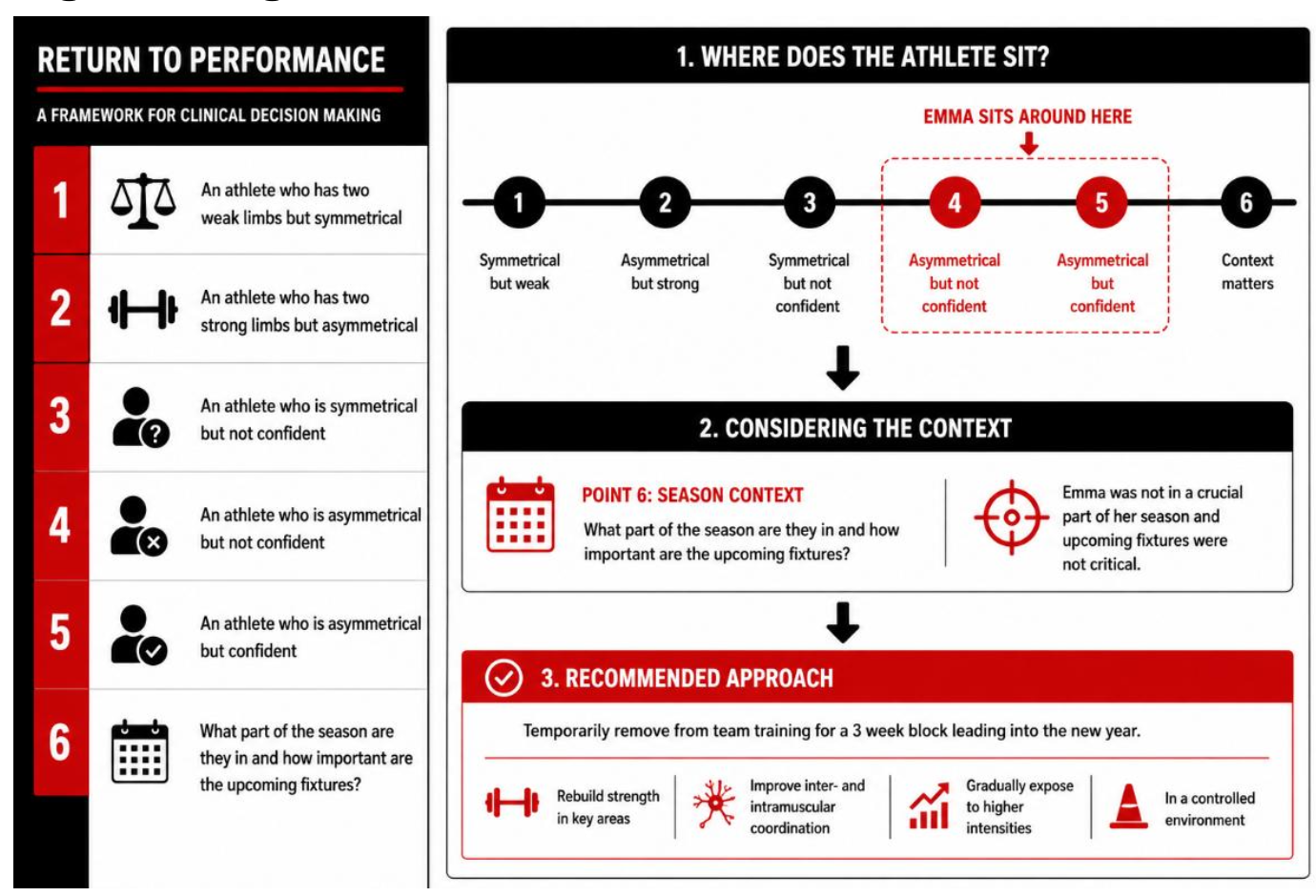
One framework I always keep in mind when starting with a new athlete is an adapted version of Matt Jordan’s return to performance model, particularly around how we view asymmetry, confidence and readiness within the bigger picture of ACL rehab. Too often we reduce return to play down to isolated metrics, when in reality it’s a constant balance between physical capacity, psychology, movement quality and the athlete’s ability to tolerate uncertainty within sport.
In Emma’s case, she probably sat somewhere between points four and five, confident enough to continue training and playing within high-level environments, but not fully confident loading and moving off the left side, particularly during more reactive and high speed tasks. Like many high-level athletes, she had become very good at compensating around those deficits and still finding ways to perform effectively.
When we then layered in point six and considered the wider context of the season, it became a much easier decision clinically. At the time, she wasn’t entering a crucial period competitively and the upcoming fixtures carried less significance, which gave us an opportunity to take a more long-term approach rather than simply prioritising short-term availability.
My recommendation after reviewing the full profile was to temporarily remove her from team training for a three-week block leading into the new year. The aim wasn’t to completely de-load her, but to create a more controlled environment where we could rebuild strength qualities in key areas, improve both inter- and intramuscular coordination, and gradually re-expose her to higher movement intensities without the unpredictability of full team training. Sometimes the biggest progress in rehab comes from temporarily stepping away from the chaos to rebuild more efficient movement solutions underneath it.
Phase 1 – Re-Build
The first phase for us was very much a re-build block. We temporarily took Emma out of team training to reduce the constant exposure to chaotic loading and instead focus on rebuilding a stronger base level of strength and ironing out some of the key asymmetries we had identified through profiling and movement assessment. A large focus was placed on improving quadriceps and glute bulk, but more importantly the intra-muscular coordination and synergy between the two.
A lot of the exercises we used were actually very simple. I think one mistake coaches sometimes make in mid-late stage rehab is trying to overcomplicate exercise selection, when often the biggest adaptations come from doing basic things really well. For example, we spent a lot of time around split squat and lunge variations with strict positional constraints. If you stop the back leg from drifting into extension, the athlete is forced to coordinate the quad and glute together to get out of the position efficiently. Once the hip drifts into extension, athletes can often “escape” the movement by recruiting elsewhere through lumbar extension, anterior hip structures or overusing posterior chain strategies.
For Emma, keeping her in positions where the glute and quad had to work synergistically was a huge focus.
We also spent a lot of time building lower limb capacity, particularly around the soleus, through a mixture of extensive and intensive plyometric work alongside targeted calf strength progressions. Given the role the soleus plays in force absorption, stiffness regulation and deceleration, it became a key area for us to rebuild before progressing towards more aggressive running exposures.
On-pitch, the emphasis wasn’t initially on conditioning or maximal speed exposure, but more on re-teaching the skill of high-intensity movement. We focused heavily on how Emma absorbed force, organised her trunk and pelvis, and then reproduced force efficiently during acceleration and deceleration patterns. Rather than just exposing her to intensity for the sake of it, we wanted to improve the quality and efficiency of the movement solutions underneath it first.
Throughout this phase we also maintained her aerobic base predominantly through off-feet conditioning methods, most notably the SPARC trainer. One of the reasons we used this heavily was because it allows the athlete to stay in a running-specific posture and shape without the same mechanical load associated with full running exposure, making it a useful tool during this stage of the rebuild.
By the end of the block, Emma’s soleus strength had improved by around 40%, alongside a 20% increase in glute max strength. Although jump testing (CMJ, SL CMJ, pogo and SL pogo) still showed around 20% asymmetry, the movement strategies and force organisation underneath the outputs were significantly improved, giving us confidence to progress into the next phase.
Phase 2 – Re-Integration
Phase two was centred around re-integrating Emma back into team training while still maintaining enough control to continue driving adaptation underneath the surface. In the gym, the heart of the programme stayed largely the same, but the emphasis shifted slightly. We reduced overall training volume and moved away from maximal strength being the primary target, instead placing more focus on rate of force development and the speed at which she could produce force through the lower limb.
On-pitch, we weren’t aggressively chasing high-intensity running metrics at this stage, largely because team training exposure was already giving her access to a lot of those outputs naturally. While our individual field sessions became more focused on gradually increasing the speed, complexity and reactivity of movement tasks. The key objective was to see how well she could organise and coordinate movement at closer to match intensities, whilst still keeping the majority of drills relatively closed and controlled to minimise unnecessary overload.
A really important takeaway from this block came through the jump profiling, particularly within the single-leg CMJ data. Although jump height itself was improving steadily, the most promising adaptation was actually the reduction in eccentric duration. Over the course of the block, Emma became significantly more efficient at absorbing and transitioning force through the eccentric phase, suggesting improved lower limb stiffness regulation, force acceptance capacity and neuromuscular sequencing under load. For me, this was one of the biggest indicators that her ability to tolerate and redistribute force eccentrically was improving, something that’s hugely important once athletes return to higher-speed deceleration and multidirectional demands.
The overall goal by the end of this phase was for Emma to successfully return to fixtures while also putting herself in a strong position heading into the upcoming Sweden Sevens camp.
Phase 3 – The Return
Phase three is where we currently sit and has really covered the last couple of months of Emma’s journey. Since progressing through the previous phases, she has now successfully returned to both Sweden 15s and Sweden Sevens training camps and fixtures, whilst also returning to regular competition with her club.
The overall structure of both gym and pitch work has remained relatively similar throughout this phase, which is something I think often gets overlooked once athletes return to play. Just because an athlete is back competing doesn’t mean the rebuilding process suddenly stops. In many ways, this can actually become one of the most important stages for an athlete who has been out for a prolonged period, because it’s very easy to lose the physical qualities and movement strategies you’ve spent months rebuilding once fixture congestion and fatigue begin to accumulate.
The biggest difference now is that the gym and pitch programme is far more reactive to her fixture schedule, training exposure and GPS outputs across both games and training weeks. Rather than chasing large physical adaptations every session, the goal becomes balancing continued development with protection and management. We still absolutely believe positive adaptations can be made during the season, but there also has to be a greater appreciation for recovery capacity, tissue tolerance and cumulative load exposure alongside performance.
Overall, Emma has been an excellent athlete to work with throughout the process, and this has been a really positive rehab journey to be part of. What has probably stood out most is her willingness to buy into the long-term process, even during periods where progress wasn’t always reflected purely through external outputs.
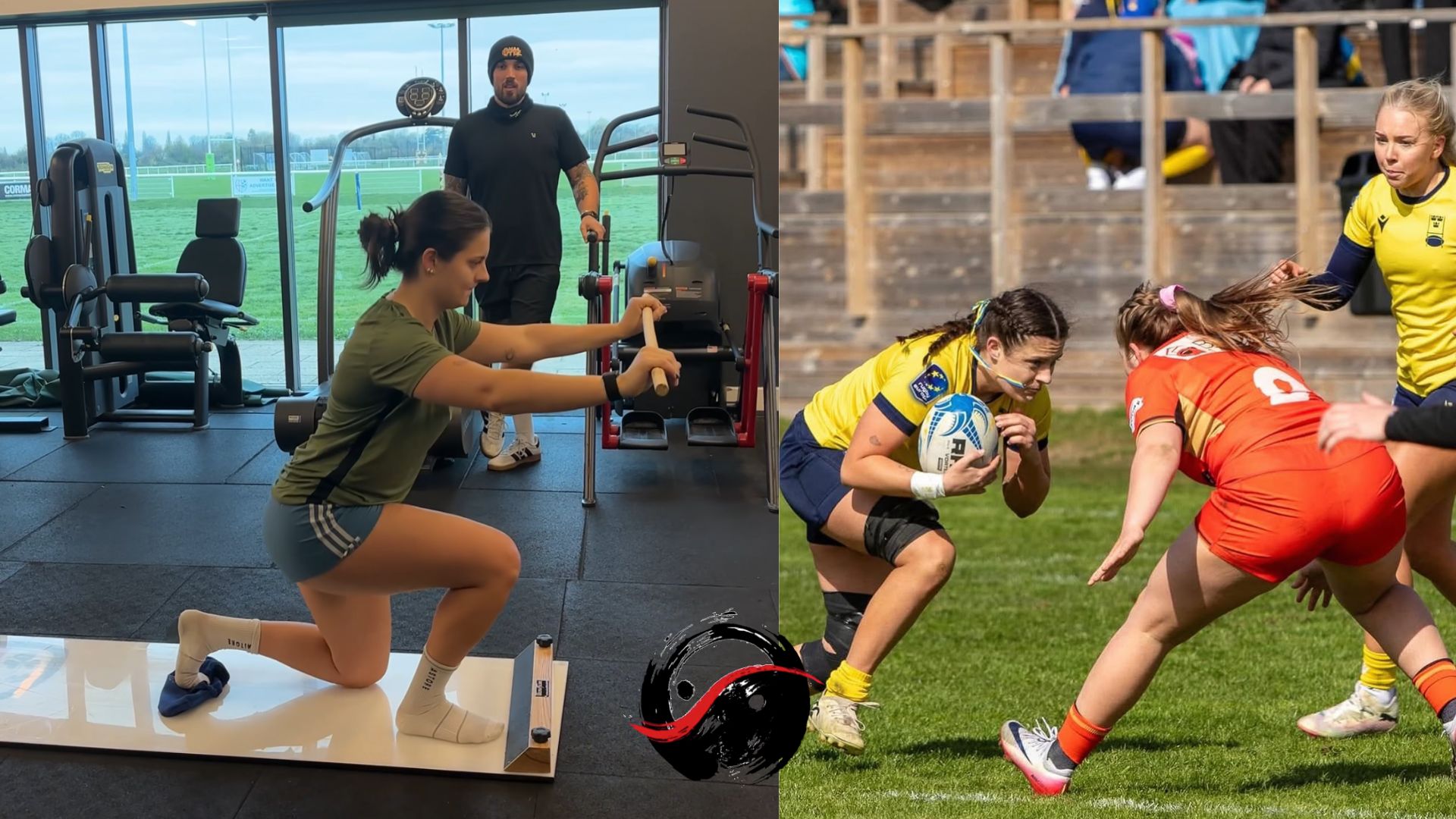
Cases like this are a good reminder that successful return to performance rarely comes from one breakthrough moment. It’s usually the accumulation of small, consistent improvements in strength, coordination, confidence and movement quality over time. Seeing her now return to international environments with Sweden whilst moving more confidently and efficiently is a great reflection of the work she has put into the process.