

Part 2/3: Standards of Performance – Bill Walsh and the Pursuit of Excellence
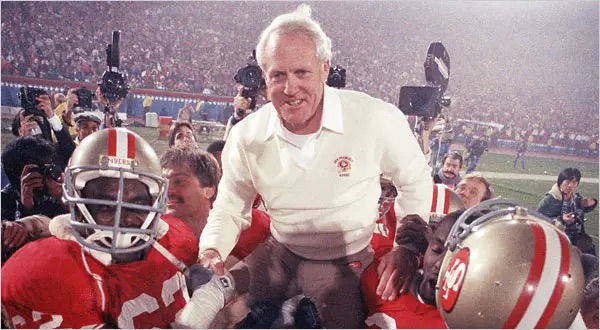
Bill Walsh
As a young coach I was constantly seeking ways to expand my knowledge and develop my coaching craft in regards to exercises, principles and practices. I knew all this was important as it was the frontline of my role, delivering to athletes and preparing them physically to perform. However I always sensed that despite how much I wanted to think the rep and set scheme I crafted on excel would influence the outcome on a Saturday, it was a relatively low determinant on success in a such a complex sport as rugby. Wasps at the time was a well-oiled machine, winning trophies and with a clear identity and philosophy, with some of the very best technical and physical coaches driving standards and leading the way in terms of rugby performance.
This era came to an end, staff changed, players moved on and success dried up, I vividly remember one of the coaches saying how all this talk of culture was “bullshit” and It was overrated and over emphasised. He was either right, had been in some pretty poor environments, or did not have the emotional intelligence to grasp that the needs and wants of individuals and a collective could be impactful one way or the other. I began exploring how culture and leadership shaped an environment, what it looked like, how it could impact on performance and why I thought it mattered. I had not seen many different environments and in the pre-social media age reaching out and connecting with coaches to have conversations was a clunkier process than it is today. I turned to books, books about successful coaches, leaders and historical figures to try and see what clues they had left.
American sport was far more established in terms of its systems, processes, professionalism and the collaborative franchise model ensured it was the most competitive sports environment in the world. To be successful when all your competitors are equally well resourced was a good starting point in the quest to find out more about high performing organisations. I liked American sports but I wasn’t really interested in the X’s and O’s although from an athletic and coaching perspective protective it was interesting. It was more how these organisations operated, what was the philosophy, culture and standards within them that created success in this most competitive arena. I looked at which teams had been successful in American football, basketball, baseball (University and National Leagues) and one of the books that I came across which was a pivotal for me was “The Score Takes Care Of Itself” which details Bill Walsh’s philosophy on leadership. The book was completed after his death but he had been working on it with author Steve Jamison for a number of years on and off but it never made it into print for a number of reasons. Bill’s son worked with Jamison to provide the world with one more lesson from his father and it’s widely recognised as an essential read for people in leadership positions in general not just sport, and was written with this in mind.
Walsh’s principles resonated with me as an individual. It reflected a lot of my beliefs and values in terms of work ethic as this is something that I have always fallen back on. As a moderately talented individual I realised very early on that a quality that I could control was effort, I might be out skilled or out thought but I was not going to be outworked. At times I when I revisit his work I am caught in a juxtaposition, questioning are we too obsessive about things or are we not obsessive enough? And as usual the truth is normally somewhere in between, finding this balance is key.
“Sweat the right small stuff.”
I certainly on reading his work at first took some of the principles from it too literally, I had lists of lists and I found great comfort in the idea that I was taking action to own the variables within my control. I misdirected a lot of energy into things that didn’t have enough direct influence on the outcome. Don’t confuse action with effectiveness.
I since look at this in a continuum;
There are things I control, things I can influence and things that I don’t control. Focussing on the two former as opposed to the latter as much as possible.
Walsh was a very stern taskmaster, very organised but also providing those with the the expertise the authority to develop and lead, making interventions provided it fitted within his framework. There was never any confusion in terms of who was in charge but he did want his coaches and players to be teachers, disseminating his philosophy with an accepted degree of freedom.
“There is no guarantee, no ultimate formula for success. However, a resolute and resourceful leader understands that there are a multitude of means to increase the probability of success. And that’s what it comes down to, namely intelligently and relentlessly seeking solutions that will increase your chance of prevailing in a competitive environment.
When you do that, the score will take care of itself.”
John Wooden looms large again in terms of Walsh’s approach, (Jamison also authored books with Wooden) his meticulous preparation and clarity in regards to roles and objectives. This is something that Wooden clearly focused on as well in terms of ensuring his athletes were expertly prepared. You can’t build sustainable success without solid foundations (Systems/Structures/Processes). The freedom to create and invent requires a stable infrastructure to guide you.
“Art lives on constraint and dies on freedom.”
 Michelangelo
This is the principle of intent based leadership, you create clarity and competency within your organisation so your staff and players can then have greater freedom to solve problems. Channelling the direction of creative/chaotic thinking towards definable outcomes provided by his guiding principles and philosophy. Thus reducing decision fatigue, enabling focus and the pursuit of mastery by detailing clearly the action that needs to be taken, allowing the opportunities for this creativity to flourish in a way that can actually be applied.
“Be a King without a crown”
As John Wooden said,
“be more concerned with finding the right way than in having your way.”
Bill Walsh transformed the San Francisco 49ers from the worst team in the NFL to champions in just two seasons. Three Super Bowl titles followed in seven years and two more under the leadership of George Seifert who had served as an assistant to Walsh. But the scoreboard was never his primary focus, it was the inevitable result of something deeper.

Bill Walsh – 49ers
Walsh was 100% clear on what his objectives were and communicated this with clarity so that everyone was aligned, knew what they were aiming for the steps and actions that they needed to take in order to obtain this. One of my favourite anecdotes (which I hope to be true) that embodies this is sentiment relates to JF Kennedy on a visit to NASA in the midst of the race to put man on the moon. The story goes that he had a conversation with the cleaner and asked him” what is your role here”? To which the employee relied, “I am helping to put a man on the moon.” Within large organisations individuals and sections can lose sight of what the real aim of their roles are, distracted by things that are important to them that can actually hinder the primary objective of the organisation.
Walsh called it the Standard of Performance. It wasn’t a motivational slogan or merely a set of tactics. It was a comprehensive philosophy about how an organization should operate, from the profound to the seemingly trivial. Shirttails tucked in. No strutting. Punctuality. Professional demeanour. Maximum effort in every detail.
Applying such standards with this detail and consistency can be incredibly time-consuming and draining. Walsh ultimately burnt out, (your strengths are also your weakness is another phrase I refer back to) retired after his third Super Bowl win. He never returned to coaching despite multiple offers, though he did return to the 49ers as a consultant and helped influence the next coach in this trilogy (Pete Carrol). Obsessive behaviour can lead to a high level of success but it is rarely sustainable or healthy. That’s why surfing between compulsion and dipping into obsession for short periods is a far more liveable way of driving your passion. Though if you are going to do exceptional things then the reality is that well preserving this balance is a very delicate act.
A key aspect of Walsh’s thinking was that most people do not know what they are capable of achieving. His work ethic was shaped by his father and as a result he set very high standards for his staff and players, pushing and driving them towards these levels of performance and accountability he believed was your duty as a leader. Relentlessly pursuing excellence is hard, but this is what you have to do if you want to be an outlier, part of the less than 1% in sport, business or performance that gets to dine at the top table.
By laying out very clearly what his standards were, reinforcing and insisting on them Walsh ensured that everyone was doing their jobs to the highest possible standard. He was adamant that people had to firstly do their job. This is also highly prominent in another football dynasty with the New England Patriots under Bill Parcells who was a key rival of Walsh and the later Bill Bellchick. The phrase “do your job” became synonymous with the Patriots way.
“You are as good as your good people”
Recruiting the right people is such a key part of an organisations success, hiring staff is such a key part of building a high performance environment but the process is often highly floored with only 2-3 hours at best devoted to getting to know someone who will be in your organisation 40 plus hours a week.
“Get good talent with good attitude, because good talent with bad attitude equals bad talent.”
Consistency Creates Culture
“We are what we consistently do. Excellence is then not an act. But a habit.”
Will Durant – The Story of Philosophy (Commenting on Aristotle and his writings)
The more you focus on yourself and developing then you less you have to worry about in terms of performing your role. You don’t have to worry because you know you have prepared and done everything you can do within your control. This personal growth, self-directed inward learning and development is always a key and thus this book should be an essential for anyone seeking high performance.
Walsh understood that greatness isn’t built through isolated moments of brilliance but through the daily discipline of doing things right.
Building from the Foundation : An Environment of Excellence
A striking aspect of Walsh’s approach was his refusal to compromise on fundamentals during a rebuild. When he inherited chaos, he didn’t wait for talent to arrive before establishing standards. He created the environment first, knowing that culture precedes performance.
This speaks to something essential in performance coaching: you cannot build excellence on unstable foundations. The principles must be non-negotiable, regardless of current results. As Walsh observed, it takes time patience and fortitude but there are no shortcuts to mastery.
His meticulous planning extended to every role in the organization. Each person received clear, detailed expectations. Communication was constant. Even cramped offices became an asset because transparency was built into the physical space. Everyone stayed in the loop.
Walsh suffered two losing seasons at the beginning of his time with the 49ers, it helped shape his philosophy and how he would approach the fragile friendship that coaches have with success.
I created my own reference phrase from his Back in the Game Checklist which he used as one of his many anchor points when times were tough.
Blame no one expect nothing do something
Bill Walsh’s : FIVE DOS FOR GETTING BACK INTO THE GAME:
- Do expect defeat. It’s a given when the stakes are high and the competition is working ferociously to beat you. If you’re surprised when it happens, you’re dreaming; dreamers don’t last long.
- Do force yourself to stop looking backward and dwelling on the professional “train wreck” you have just been in. It’s mental quicksand.
- Do allow yourself appropriate recovery, grieving time. You’ve been knocked senseless; give yourself a little time to recuperate. A keyword here is “little. ” Don’t let it drag on.
- Do tell yourself, “I am going to stand and fight again, ” with the knowledge that often when things are at their worst you’re closer than you can imagine to success. Our Super Bowl victory arrived less than sixteen months after my “train wreck” in Miami.
- Do begin planning for your next serious encounter. The smallest steps, plans move you forward on the road to recovery. Focus on the fix.
MY FIVE DON’TS:
- Don’t ask, “Why me?”
- Don’t expect sympathy.
- Don’t bellyache.
- Don’t keep accepting condolences.
- Don’t blame others.
The 80/20 of Control
Walsh was pragmatic about what lay within his control. Twenty percent, luck, weather, opponent quality which remained outside influences. But the other eighty percent he believed he could control in terms of preparing his team and maintaining standards. That demanded absolute focus and preparation.
This is where most organizations fail. They obsess over the uncontrollable or use it as excuses. Walsh’s philosophy inverted this;
relentless preparation in the controllable created the conditions for success when luck arrived.
Preparation was systematic but it was not rigid, he had contingency plans ready for multiple scenarios and was able to flip to a plan D if required. It also meant getting creative within limitations, turning constraints into advantages. The West Coast Offense itself was born from this mindset, finding solutions that would work rather than reasons things couldn’t.
The Inner Voice
One of Walsh’s most profound insights was that, “the inner voice of your people is more influential than any external motivation”. Shouting and Churchillian speeches have diminishing returns. What matters is the voice inside each athlete’s head during critical moments.
As a leader, you determine what that inner voice says through how you build standards, give feedback, and create culture. Constructive criticism over demeaning critique. Positive language over constant negatives. “I believe in you” is the most powerful phrase in your vocabulary.
This doesn’t mean softness. Walsh was clear about needing a hard edge, the ability to make ruthless decisions swiftly and fairly. But effective leadership blends honesty with diplomacy, firmness with flexibility. The goal is to develop autonomous, thinking athletes who perform because they’ve internalised excellence, they are self-regulating and reflecting on their standards of performance which are shaped by the ones you set. In addition to this successful teams self-regulate each other, so the leader does not need to micro manage these standards and any drift from them is far more effectively corrected by peers and teammates once the environment has been crafted and is stable.
Culture and Character Trump Talent and Personality
“Be more concerned with your character than your reputation, because your character is what you really are, while your reputation is merely what others think you are.”
John Wooden
This in a psychological sense relates to the concept of our public and private self. The public self is often created to appeal to other goals, biases and does not necessarily reflect their true character, values and beliefs. This was key to Walsh’s approach with recruitment, he wanted character not personality.
Mastery as Process
There is no mystery to mastery, it requires intelligently directed hard work based around the fundamental skills of your sport or profession as the basic requirement. I believe people know that this is what is required in large to be successful, it is though boring and as such people choose to resist, being distracted from the work as opposing to persisting with targeted focussed work.
As Vince Lombardi stated,
“to go high you have to pay the price, the higher you go the more you have to pay,”
Walsh’s final principle became the book’s title: focus on the process, and the score will take care of itself.
This is perhaps the most challenging mindset to maintain. Results create pressure to abandon process. Success breeds complacency. Failure tempts shortcuts. The scoreboard screams for attention.
But Walsh understood that mastery is continuous refinement of fundamentals. It’s training, then training more. It’s never being satisfied while simultaneously celebrating progress. It’s the daily work ethic that precedes strategy, tactics, and talent.
The Standard of Performance wasn’t about perfection, it was about creating the conditions where excellence becomes inevitable. Small details compound until they produce something that appears effortless, providing the beautiful illusion of art and sport that it looks easy, People see a moment of “genius”, a great play that looks off the cuff an act of creativity in the moment. But this moment is layered in the work, purposeful practice and attention to detail that allows a decision to be made. Tricking the observer that this is instinctive and unpractised, when the truth is the process of creativity is born from the unglamorous repetition of basic skills and practice. With deliberate variability that prepares performers for the moment when it presents itself.
“A diamond is just coal that did its job.” Leornado Di Vinci
Professional behaviour becomes identity. Clear communication eliminates confusion. Rigorous preparation meets opportunity.
Application
For those of us working in performance environments, Walsh’s blueprint offers something rare, a complete philosophy that bridges the gap between aspiration and execution.
We can debate periodisation models and testing protocols. We can argue about exercise selection and loading schemes. But without the foundational commitment to standards, without the daily discipline of doing everything right we’re building on sand.
The question Walsh poses to every coach and organisation is simple but uncomfortable:
Are you truly doing everything within your control to create excellence, or are you hoping results will somehow arrive despite compromised standards?
The score will take care of itself. But only if we take care of everything else first.
Tappers.