

Tom Farrow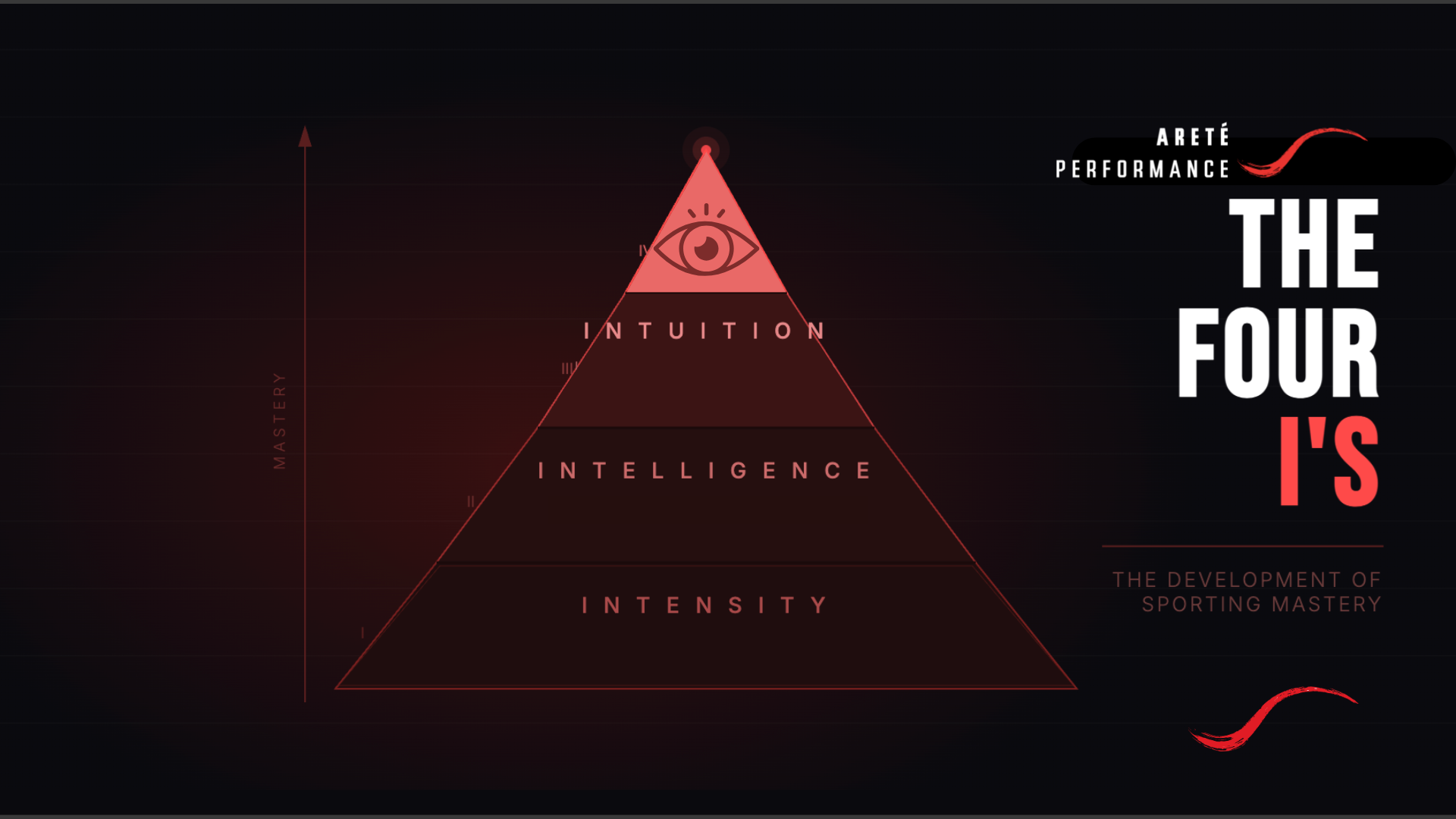
There’s an idea you sometimes hear in performance circles – a myth of sorts that seems to permeate social media feeds and the broader ‘performance’/fitness industry beyond that. You’ve probably heard it in a variety of forms, but it usually goes something like this: If two people have a fight, all other things being equal, the one who tries hardest will likely win.
The problem is, all other things are never equal.
The Four ‘I’s is a concept I use to think about skill development and how that skill is tactically expressed within sport.
A lot of the online narrative would have you believe that all you need to do to achieve mastery is work harder. If only things were so simple… While effort is a non-negotiable in pursuing the path of getting good at anything, it will only get you so far. The higher up the path you go, the less likely effort is going to be the limiting factor.
Effort isn’t enough and it can’t be applied blindly – how you spend your energy is more important than how much you spend.
To do better, you actually need to be better. But ‘better’ isn’t a fixed state we can achieve and rest at; it’s a moment-to-moment interaction with the task or opponent you’re engaged with.
Within various phases of my life so far, I’ve learnt and relearnt the lesson that working harder doesn’t mean you’ll succeed. In the context of the Four I’s though, ‘Intensity’ doesn’t just mean what it traditionally does in popular language. For me here, it also encompasses all the physical qualities that make up the rate and magnitude of work we’re able to apply to a task; strength, power, speed, ‘fitness’ and whatever other physical quality you’re into. In the sporting sense, I’ve also learnt that being stronger, more powerful, faster, or fitter isn’t necessarily the solution either.
These lessons landed most effectively when they came painfully – via boxing and wrestling mainly. I would encourage all third-year strength and conditioning students (physio students could do with tagging along as well) to go to their local wrestling gym and pair themselves up with someone much smaller than themselves, who has 2 years or so experience (1 year may actually be enough to get the point). The realisation will soon arrive that strength is only as useful as being able to apply it in the right way at the right moment.
It’s at this point you may progress up towards the pyramid into the intelligence phase of learning.
Intelligence
Anyone who’s learnt anything is familiar with this phase (also recognised as ‘conscious incompetence’ within Skill Acquisition circles). This is where you may have been taught a technique and you have an idea of what is supposed to happen as a result of that technique, but you’re in the clumsy stage of trying to connect what you want to happen with what actually happens.
I spent many sparring sessions in boxing against opponents who I was confident I could punch faster than. The problem was – I couldn’t punch them. Not because my arm wouldn’t move quickly enough. It did. But whenever I threw, they’d glide—just slightly—out of range. And then, almost politely, they’d send something back at me that landed cleanly. I could see it coming the whole way. I just couldn’t do anything about it. What was going on?
Despite me being able to move my arms and feet faster than those opponents, they had many things I didn’t; balance, timing, understanding of distancing, an array of effective feints, subtle sells that would draw me out of position, and an economy of movement that revealed whatever intensity I was able to bring to be only noise. Essentially – they had skill. Like wrestling, boxing is a quick and practical way to understand the difference between physical abilities and skill.
Once at the level where you can perform the techniques associated with your chosen discipline consistently well (when the outcome associated with the technique is consistently the same as the outcome you desired), you’re at the level of Intuition.
Intuition
In many disciplines, it may take a long time to get to this phase, in others less so. From a coaching perspective, the athlete is there when they can perform a task without having to focus on how they perform the task (Unconscious Competence).
This phase basically speaks for itself and it’s tempting to think this is the destination. Intuition may feel like mastery because it feels effortless. But in sports where you face an opponent, being able to perform the skill automatically is only as relevant as being able to perform it in relation to your opponent. So, once you’re not spending all your attention on how you execute the skill, you can spend it on something more important. You’re now free to focus on the top of the pyramid – Pay Attention.
Pay Attention
The top of the pyramid – the All-Seeing ‘I’ relates to the actions and tactics an athlete uses to achieve a desired outcome. Whereas the broader outcome may be ‘win the game’, but that’s just the headline. The real work is thousands of micro-battles: little opportunities and threats appearing and disappearing in fractions of a second
This, for me, is the most forgotten aspect of performance sport. Because it’s the hardest to measure. It’s much easier to focus on ‘getting stronger’ or ‘running more’ than it is on executing better decisions, as it’s much harder to track what a better decision is (it’s easier in hindsight but sport isn’t played in hindsight – it’s played in the moment) and it’s much harder to define what’s required to develop and maintain this ability.
At the highest levels of sport, this is often the distinguishing factor.
The best players execute better decisions more consistently than other players. They also make fewer poor decisions. They take whatever physical and technical abilities they have and express them effectively in the arena of competition.
Or as we often say at Areté (because we’re yet to find a cleaner way of simply expressing this idea):
“The best players are the best players because they’re the best players…”
We all know what this looks like. We can all name athletes who aren’t the biggest or most physically dominant, but who dominate their sport anyway. We’ve all played alongside someone less fit, less fast, less strong—who is still better.
Not because they want it more.
Because they notice more. And because they’re able to effectively act on what they notice.
Paying attention is staying attuned to the opportunities that present themselves from moment to moment within competition. It’s remembering that regardless of the physical or technical ability of your opponent, you can still see something they don’t—and you can still execute better in that moment.
This is where the sport becomes less about “hard work” and more about your relationship with the moment you’re presented with.
Summary
None of this is meant to downplay the importance of physical and technical ability though. It’s meant to place them in their rightful place.
Developing physical and technical abilities affords you more opportunities within the competitive arena. If you’re faster, options become available that aren’t available to a slower player. If you change direction more effectively, the same. If you can execute a skill with less effort—if, in rugby, you can accurately pass 20m off your non-dominant hand while running fast—your palette expands. More aspects of the game become available to you.
So our role as coaches is to understand how these qualities relate, and to help athletes focus on the appropriate quality at the appropriate time. Because time is limited. Energy is limited. Sporting careers are short.
You can spend a lot of time with your head down, telling yourself “More is more,” mistaking exhaustion for progress—while missing the work that actually moves performance forward.
And just to be clear: this isn’t necessarily a bottom-up pyramid. It can be built top-down or bottom-up. There are benefits to both, and a mix is usually best. But that’s a longer conversation for another day.